Boosting Printer Performance & Lifespan with Slkor's SLPESD5V0S2BT: Next-Gen ESD Protection Power
In modern office environments, printers remain essential output devices, and the reliability of their internal circuitry directly impacts lifespan and user experience. Yet electrostatic discharge (ESD) continues to be an invisible but destructive threat to stable printer operation. Static voltage generated from human touch, paper friction, or dry air can easily reach several thousand volts. Without effective suppression, these surges can damage sensitive components such as control chips and sensors.
Slkor’s SLPESD5V0S2BT, an ESD protection device engineered for low-speed signal lines, provides a high-efficiency and cost-effective safeguard for printer circuitry. With its precise electrical parameters and compact footprint, it delivers reliable protection against static events — helping printer systems operate longer, safer, and more consistently.
Press enter or click to view image in full size
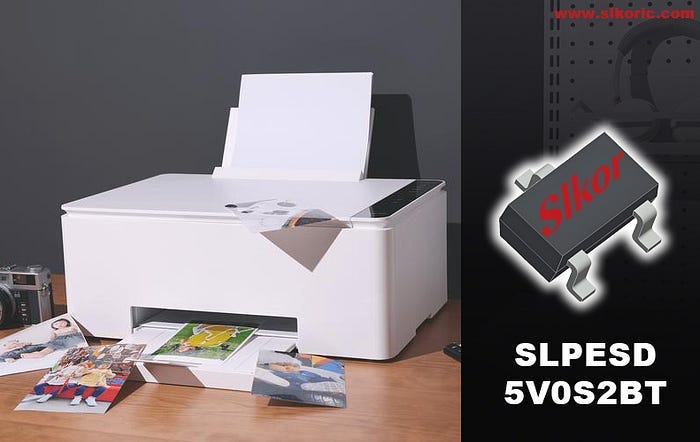
1. Electrostatic Threats and Protection Needs in Printer Circuits
Inside printers, there are multiple low-speed control signal lines — such as paper-sensor interfaces, button-control signals, motor-drive signals, and LED status indicator lines. These lines typically operate below 1 MHz and have relatively modest signal-integrity requirements. However, they face several significant electrostatic risks:
- Human Contact Discharge: When users touch the printer’s casing or external interfaces, static buildup on the human body can be transferred into internal circuits through metal connectors.
- Paper Friction Charging: Static charge created by friction between paper, rollers, and sensors during feeding can travel through mechanical assemblies into the control board.
- Environmental Static Accumulation: In dry climates, plastic components rubbing against surrounding air can generate electrostatic fields, leading to indirect discharge events.
Traditional protection methods often rely on varistors or Zener diodes. However, varistors suffer from slow response and high leakage current, while Zener diodes — with their high junction capacitance — can degrade signal quality. The introduction of the SLPESD5V0S2BT addresses this gap by delivering fast response, low capacitance, and targeted ESD protection specifically for low-speed control lines.
2. Core Parameters of SLPESD5V0S2BT
The device’s specifications are engineered to precisely match the protection needs of printer control circuits:
VRWM = 3.3V: The maximum working voltage fully supports the 3.3V rails and digital signal levels commonly found in printers. This ensures the device remains in a high-impedance state during normal operation, preventing any interference with signal transmission.
VBR ≥ 4.5V: The breakdown voltage is accurately positioned above the safe operating range, allowing the device to distinguish normal voltage levels from ESD transients — effectively avoiding false triggering.
VC = 7V (at 8/20μs): Under the standard 8/20μs ESD pulse, the clamping voltage is tightly controlled to within 7V — significantly lower than the breakdown voltage of most CMOS components (typically above 10V). This provides a generous protection margin for downstream circuits.
CJ = 60pF: The junction capacitance is optimized to balance robust protection with signal integrity, making it ideal for low-speed control buses (including I²C and SPI) and general digital signal lines. This helps prevent distortion or attenuation caused by excessive capacitive loading.
IR=125μA (at VRWM): The extremely low leakage current ensures that the device does not significantly increase system power consumption over time, making it particularly suitable for battery-powered portable printers.
3. Typical Application Scenarios and Layout Optimization
In printer circuit designs, the SLPESD5V0S2BT can be deployed at several critical protection points:
- Sensor Interface Protection:
Place the device in parallel with analog signal inputs such as paper-detection sensors and cover switches to suppress electrostatic surges and safeguard upstream operational amplifier circuits. - Button Control Module:
Provide bidirectional ESD protection for matrix keyboard row/column lines or individual key inputs, preventing electrostatic discharge from damaging control chips when users interact with tactile buttons. - Motor Drive Lines:
Integrate the device into stepper or DC motor control signal paths to prevent potential failures caused by back EMF or external static electricity during motor startup or shutdown. - LED Driver Circuit:
Add electrostatic buffering to PWM control signals for status indicator LEDs, ensuring consistent and stable performance of the lighting modules.
In terms of packaging, the compact SOT-23 footprint (2.9 × 2.8 × 1.45 mm) enables engineers to position the device close to connectors or signal entry points that are most vulnerable to electrostatic strikes. This minimizes the protection path length while reducing the effect of parasitic inductance on response performance. For optimal layout, it is recommended to follow the principle of placing the ESD device as close as possible to the protected component, while ensuring the grounding path is short and direct to maximize energy dissipation efficiency.
4. Reliability Verification and Cost Advantages
Slkor’s SLPESD5V0S2BT has successfully passed IEC 61000–4–2 Level 4 tests (8kV contact discharge, 15kV air discharge), meeting the stringent electrostatic protection requirements of industrial-grade environments. Compared with multilayer varistors (MLVs) and polymer ESD suppressors, this device stands out with its ultra-fast sub-nanosecond response time, excellent temperature stability (operating from –55°C to 150°C), and robust long-term reliability.
From a cost-efficiency standpoint, a single SOT-23 ESD diode offers a far more economical solution than assembling discrete protection circuits — without consuming additional PCB area. For mid- to high-end printer product lines with annual volumes in the tens of thousands, adopting this integrated protection design can reduce board-level costs by approximately 15%–20%, while also enhancing production throughput and overall assembly efficiency.
5. Industry Application Expansion and Future Trends
As printers evolve toward higher intelligence, the integration of WiFi modules, touch panels, and other advanced components brings greater challenges for electrostatic protection. The low-capacitance characteristics of the SLPESD5V0S2BT make it an ideal choice for protecting 2.4GHz wireless communication lines, effectively preventing signal degradation caused by excessive junction capacitance in traditional ESD components. Its bidirectional conduction capability also makes it well-suited for differential signal protection — such as LVDS display interfaces commonly found in modern printers.
Looking ahead, as IoT devices continue to push for miniaturization and enhanced reliability, specialized protection devices like the SLPESD5V0S2BT — offering both high performance and cost-effectiveness — will become increasingly essential in office equipment including printers and scanners. By precisely aligning protection device characteristics with the electrical demands of each system, engineers can build a robust, multi-level electrostatic protection architecture from PCB to system level, ultimately extending product lifespan and significantly reducing long-term maintenance costs.
About Slkor:
SLKOR, headquartered in Shenzhen, China, is a fast-growing national high-tech enterprise in the power semiconductor industry. Backed by R&D centers in Beijing and Suzhou and a core technical team originating from Tsinghua University, SLKOR has rapidly emerged as an innovator in silicon carbide (SiC) power device technology. Its products are widely deployed in new energy vehicles, photovoltaic systems, industrial IoT, and consumer electronics, delivering essential semiconductor solutions to more than 10,000 global customers.
The company ships over 2 billion units annually, with its SiC MOSFETs and 5th-generation ultrafast recovery SBD diodes setting new industry standards in power efficiency and thermal performance. Holding more than 100 invention patents and offering over 2,000 product models, SLKOR continues to expand its IP portfolio across power devices, sensors, and power management ICs. Certifications such as ISO 9001, EU RoHS/REACH, and CP65 further underscore the company’s commitment to technological innovation, lean manufacturing, and sustainable development.


Comments
Post a Comment