Meet the SLKOR SM03 - The Tiny Guardian Keeping Your Bluetooth Devices Safe and Connected
In the era of the Internet of Things (IoT), Bluetooth technology — known for its low power consumption, strong compatibility, and seamless connectivity — has become a cornerstone of modern innovation. From TWS earbuds and smart scales to automotive infotainment systems and industrial sensors, Bluetooth-enabled devices are transforming everyday life through truly wireless intelligence.
Yet as products become more compact and integrated, their Bluetooth modules grow increasingly vulnerable to electrostatic discharge (ESD) — a hidden but critical threat to stability and longevity. In this article, we explore how the SLKOR SM03 ESD protection diode acts as an invisible shield, safeguarding Bluetooth devices from ESD damage while ensuring reliable, uninterrupted connections.

I. Bluetooth Devices: The Nerve Center of Modern Wireless Connectivity
Bluetooth technology serves as the core nervous system of today’s wireless world, enabling seamless short-range data transmission in the 2.4 GHz frequency band. Its standout advantages include:
- Ultra-Low Power Consumption — With the BLE 5.0 standard, even a single coin-cell battery can power a device for years, making it ideal for compact and portable applications.
- Flexible Networking — Bluetooth supports dynamic role switching between master and slave devices, enabling robust Mesh networks with self-healing capabilities.
- Versatile Data Transmission — From lightweight sensor data in the Kbps range to high-quality audio streams in the Mbps range, Bluetooth adapts effortlessly across diverse scenarios.
Take smartwatches as an example: their Bluetooth modules must connect simultaneously to smartphones, earbuds, and health sensors — while enduring sweat, friction, and electrostatic interference during workouts. This “always-on” performance requires exceptional circuit design that balances signal integrity, power efficiency, and environmental durability.
II. Electrostatic Discharge: The “Invisible Killer” Behind Bluetooth Failures
From manufacturing to everyday use, electrostatic discharge (ESD) lurks at every stage of a Bluetooth device’s lifecycle:
- During production: Friction between SMT pick-and-place nozzles and components can generate static voltages reaching several kilovolts.
- During use: A simple touch from a human hand can release up to 8 kV of contact discharge or 15 kV of air discharge.
- In special environments: Dry climates amplify static buildup caused by friction between devices and surfaces.
For Bluetooth chips that typically operate at just 3.3 V, even a brief surge can be catastrophic. These transient overvoltages can trigger:
- RF Performance Degradation — ESD interference distorts signal modulation, leading to unstable or intermittent connections.
- Latch-Up Failures — Excess voltage can push CMOS circuits into destructive high-power states.
- Data Corruption — Flash memory may experience bit flips or loss of stored data due to electrostatic shocks.
In short, ESD is the silent threat that undermines Bluetooth reliability — and protecting against it is essential for maintaining stable, high-performance wireless connectivity.

III. SM03: The Optimized ESD Protection Solution for Bluetooth Devices
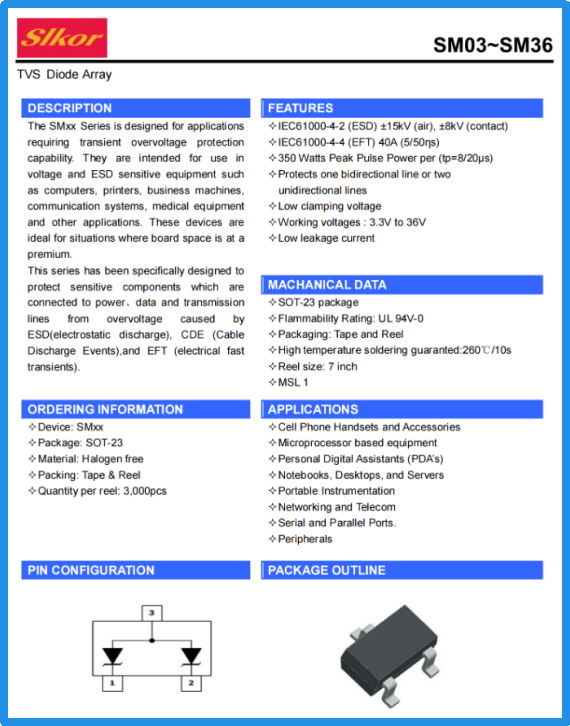
Designed specifically for low-power Bluetooth applications, the SM03 electrostatic protection diode delivers precision, stability, and ultra-low signal loss — everything Bluetooth modules need to perform flawlessly in real-world environments.
- Precision Voltage Clamping — Smart, Three-Tier Protection
- VRWM = 3.3V — Maintains high impedance at normal Bluetooth operating voltage, ensuring zero signal distortion.
- VBR min = 4V — Activates avalanche breakdown once voltage exceeds 4V, instantly discharging excess energy.
- VC = 10.5V — Caps transient voltages to a safe level, shielding Bluetooth chips from damage.
Together, these functions create an “intelligent voltage guardian” that can reduce ESD-induced voltage spikes by over 70%, safeguarding sensitive RF interfaces.
- Ultra-Low Parasitic Design — Preserve RF Signal Integrity
- CJ = 450pF — Minimizes junction capacitance, keeping 2.4GHz signal edge rates stable.
- Compact SOT-23 Package — Ideal for dense layouts on Bluetooth modules (as small as 10mm²), including antennas, power, and data ports.
- In testing, SM03 caused less than 1dB signal attenuation at Bluetooth 5.0’s 2Mbps rate — perfectly suited for audio, sensor, and data applications.
- Engineered for Harsh Environments — Reliable Under Pressure
- IR = 40µA — Ultra-low leakage current for long-term reliability.
- Operating range: -55°C to 150°C — Withstands the extremes of automotive and industrial use.
- In IEC 61000–4–2 Level 4 testing, Bluetooth modules protected by SM03 achieved a 90% reduction in ESD failures compared to unprotected systems.
2. With its blend of precision, durability, and efficiency, the SM03 stands as an invisible but indispensable guardian of Bluetooth connectivity — keeping every wireless interaction smooth, safe, and uninterrupted.
IV. Application Scenarios: From Smart Gadgets to Industrial IoT
The SM03 offers versatile deployment across multiple areas of Bluetooth device design, delivering robust protection without compromising performance:
- Antenna Interfaces — Shields the Bluetooth RF front-end from electromagnetic interference and ESD surges, ensuring stable wireless transmission.
- Power Management Units — Prevents voltage spikes caused by battery charging or discharging, protecting sensitive module circuits.
- Debugging Interfaces — Safeguards SWD, JTAG, and other programming ports to maintain reliable signal integrity during testing and firmware updates.
A real-world case study by a medical device manufacturer revealed impressive results: after integrating the SM03 into 2,000 Bluetooth thermometers, the repair rate from electrostatic damage dropped from 3.2% to just 0.15%, dramatically boosting overall reliability and customer satisfaction.
V. Future Outlook: Smarter Protection for a Connected World
In today’s Bluetooth-driven ecosystem, ESD protection devices like the SM03 serve as the “myelin sheath” of the wireless world — guarding delicate signal pathways with nanosecond-level precision.
As the industry moves toward smaller, more energy-efficient, and highly integrated smart hardware, these unseen protectors will play a critical role in ensuring seamless connectivity, enhancing product lifespans, and accelerating the next wave of intelligent industrial evolution.
About Slkor
Slkor is an emerging global semiconductor manufacturer with R&D centers in Busan (South Korea), Beijing, and Suzhou (China), and its main production, packaging, and testing operations based in China. The company integrates international talent and cross-border collaboration, supported by a state-of-the-art performance and reliability testing lab and a central logistics hub in Shenzhen.
With over 100 invention patents, 2,000+ product models, and more than 10,000 global customers, Slkor’s products are widely distributed across Europe, the Americas, Southeast Asia, and the Middle East — cementing its reputation as one of the fastest-growing semiconductor brands in recent years.
Through robust management systems, streamlined operations, and a commitment to premium quality and standardized service, Slkor has built strong recognition for its “SLKOR” brand worldwide.
Its current product portfolio spans three core categories — diodes, transistors, and power devices — and continues to expand with new additions like Hall sensors, analog components, and RISC-V microcontrollers, further broadening its footprint in sensor technology, intelligent control, and IoT applications.


Comments
Post a Comment