Optimizing Battery-Powered Designs with SL3401A & S8050: Proven Low-Power Circuit Strategies
With the rapid rise of portable electronics, battery life has become a defining measure of product competitiveness. Low-power battery circuit design sits at the heart of extending operating time and improving user experience.
In real-world engineering practice, one critical challenge repeatedly emerges: how to completely cut off current when a device is powered down, eliminating hidden standby consumption and preventing unnecessary battery drain.
In this article, Sun Gaofei, engineer at Slkor Semiconductor, delivers a clear and practical breakdown of the core design principles and implementation strategies for ultra-low-power battery circuits, helping engineers achieve longer battery life through smarter power control.

In battery low-power circuit design, the power-on architecture is the first critical step to ensure reliable device operation. A widely adopted and proven approach is the smart combination of the Slkor SL3401A PMOS with the Slkor S8050 NPN transistor, delivering both simplicity and efficiency.
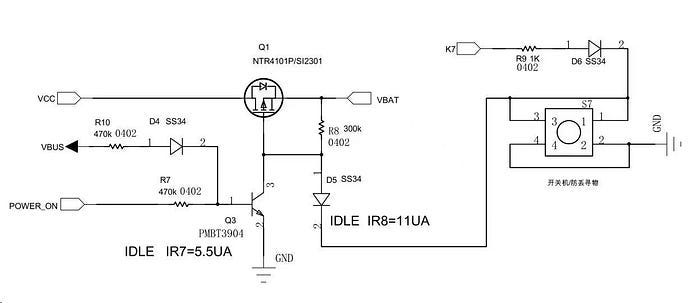
When the power button SW is pressed, the circuit logic immediately transitions. The base of the Slkor S8050 (Q1) receives a proper bias voltage, driving Q1 into conduction. Once turned on, Q1 functions like an electronic gate, smoothly connecting battery power to the system. As a result, the main control chip is powered up and enters its active operating state.
Simultaneously, the POWER ON control pin of the main control chip outputs a high-level signal, effectively latching the power supply circuit in the ON state. Even after the power button SW is released, the device continues to operate stably, as the power path remains locked.
This design not only enables a convenient one-button power-on experience, but also guarantees stable and continuous power delivery after startup, providing a solid and reliable foundation for all subsequent system operations.
When the device needs to power off, precise circuit control becomes the key to achieving ultra-low power consumption. By pressing and holding the SW button again, the main control chip — through its internal detection logic — quickly identifies the shutdown command. It then drives the POWER ON pin from a high level to a low level, immediately changing the state of the circuit.
This transition directly affects the Slkor S8050 NPN transistor (Q1). Once the bias voltage is removed, Q1 turns off, which in turn causes the Slkor SL3401A PMOS to cut off. The power path is fully closed, the battery is electrically isolated from the system, and the device shuts down cleanly. Most importantly, no current flows through the circuit after power-off, achieving true zero standby power consumption and effectively preventing hidden battery drain during idle periods.
In real-world applications, charging scenarios are unavoidable, and charging-state power management is equally critical. In special cases where an external charger is connected, a VBUS high-level signal is generated. This signal forces the charging circuit to activate, temporarily overriding the normal power-control logic. Once the main control chip detects the VBUS high level, it seamlessly switches into charging mode and begins replenishing the battery. When the charger is unplugged, the VBUS signal disappears, and the circuit automatically disconnects the power path, preventing unnecessary current consumption and preserving low-power performance.
As a professional semiconductor manufacturer, Slkor Semiconductor is committed to delivering cost-effective, high-reliability components to engineers and enterprises worldwide. From foundational devices such as PMOS and NPN transistors to high-performance main control chips, Slkor provides complete solutions tailored to diverse design requirements. Beyond components, Slkor also offers comprehensive application-level design guidance. For battery low-power circuit projects, Slkor’s technical team delivers end-to-end support — from circuit architecture and component selection to debugging and optimization — helping customers overcome design challenges and ensure robust, efficient solutions.
In conclusion, battery low-power circuit design demands careful planning at every stage, including power-on, power-off, and charging management. By intelligently combining semiconductor devices and well-structured logic control, designers can achieve ultra-low power operation — and even true zero power consumption after shutdown. Backed by high-quality products and professional technical support, Slkor Semiconductor empowers engineers to build more competitive, longer-lasting portable electronic devices.
Press enter or click to view image in full size


Comments
Post a Comment