Smarter Power Starts Here: Slkor MBRF30200CT for High-Speed, Low-Heat Performance
In the constant hum of 5G base stations, the precise speed control of electric motors in new energy vehicles, and the instant when photovoltaic panels convert sunlight into electricity, a quiet revolution in power electronics efficiency is unfolding. At the heart of this transformation, Slkor’s MBRF30200CT Schottky diode is pushing performance to new heights — combining high-frequency, low-loss operation with masterful thermal management. With these dual breakthroughs, it is redefining what engineers can expect from modern power devices.
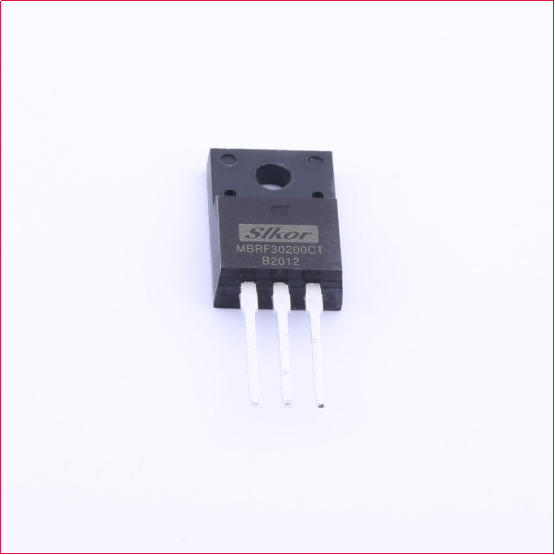
1. The Efficiency Key in the High-Frequency Era: The Technological Leap Behind the 1.14V Forward Voltage Drop
Traditional power diodes face a classic trade-off in high-frequency switching — almost like trying to “have your cake and eat it too.” Lowering the forward voltage drop often compromises switching speed, while pushing switching frequency higher usually causes conduction losses to surge. Through innovations in materials engineering and device structure, the MBRF30200CT breaks this limitation, achieving an ultra-low 1.14V forward voltage drop at 30A while compressing reverse recovery time to the nanosecond level.
This breakthrough has triggered a ripple effect in switching power supply design. After adopting the device, one brand’s 65W PD fast charger improved system efficiency from 91% to 94%, while temperature rise dropped by 7°C. Even more importantly, engineers were able to raise the switching frequency from the traditional 200kHz to 500kHz, shrinking the transformer volume by 40% without sacrificing efficiency — pushing fast-charging products toward thinner, lighter, and more compact designs.
In communication equipment, this high-frequency capability becomes even more valuable. Within 5G base station power modules, the MBRF30200CT enables MHz-level switching frequencies, reducing power supply size to around 60% of traditional solutions while still meeting strict EMI requirements. As one engineer aptly described it: “It turns power supply design from a ‘dancing elephant’ into a graceful ballet dancer.”
2. Thermal Control Artistry: The Heat Dissipation Philosophy Behind a 200V Rated Voltage
The long-term reliability of power devices ultimately comes down to one critical factor: thermal management. The MBRF30200CT applies packaging optimized through 3D thermal simulation, reducing thermal resistance to 1.8 °C/W — an improvement of 18% in heat dissipation efficiency compared with similar devices.
This design advantage becomes especially clear in solar inverter applications. After adopting the MBRF30200CT, a residential photovoltaic system operating continuously in a 45 °C ambient environment recorded a 12 °C reduction in junction temperature, while overall system conversion efficiency increased by 0.8%. With an annual generation of 5,000 kWh, that improvement translates into an additional 40 kWh of electricity per year — roughly equivalent to the carbon absorption of two fir trees.
Its robustness is further proven in industrial motor drive environments. In a servo system on an automation production line tested across an extreme temperature range of –20 °C to 85 °C, the MBRF30200CT operated continuously at 15 A for 1,000 hours with performance degradation below 1.5%. Engineers noted that its common-cathode dual-diode structure not only simplifies circuit layout but also helps achieve dynamic thermal balance through thermal coupling, ensuring stable performance even under demanding conditions.
3. Cross-Field Technological Resonance: From Consumer Electronics to Green Energy
In new energy vehicle motor controllers, the MBRF30200CT combines a 200V voltage rating with 15A rectifying capability, making it perfectly suited for 48V mild-hybrid systems. Test data from an automotive manufacturer revealed that after integrating this device, motor response speed improved by 22%, while the control circuit board area shrank by 35%, creating new possibilities for more compact and highly integrated vehicle electronics.
In consumer electronics, the device is reshaping how power adapters are designed. A leading brand’s 100W laptop charger, after optimizing PCB layout and leveraging the MBRF30200CT’s high-frequency switching advantages, managed to consolidate three traditional circuit boards into a single design. The result: charger thickness reduced from 28mm to 18mm and overall weight lowered by 30% — a shift that enhances user experience while pushing the industry closer to sleeker, more integrated power solutions.
Within data center power modules, the diode’s low-loss characteristics deliver significant energy-saving benefits. After deployment in a supercomputing facility, the power supply efficiency of each server increased by 2%. Across a data center operating 100,000 servers, this improvement translates into electricity savings equivalent to reducing approximately 1,200 tons of CO₂ emissions annually. It perfectly reflects Slkor’s core engineering philosophy: true technological innovation should deliver both economic value and environmental impact.
4. Design Methodology: Four Golden Rules to Unlock Maximum Performance
- Thermal Budget Control:
To maintain optimal reliability, a composite cooling solution combining graphene heat sinks and thermal conductive adhesive is recommended, ensuring the junction temperature remains below 125 °C. Testing shows this advanced thermal design can extend device lifespan up to 2.3× longer than conventional heat dissipation methods. - Circuit Topology Optimization:
In LLC resonant converters, carefully adjusting dead-time parameters allows designers to fully leverage the device’s ultra-fast reverse recovery characteristics. In one real-world application, this fine-tuning delivered an additional 0.6% improvement in system efficiency — a significant gain in high-performance power systems. - Layout Artistry:
Adopting a “thermal–electrical separation” PCB layout strategy — placing heat-generating components away from sensitive control circuits — helps achieve both performance and stability. This design approach can reduce electromagnetic interference by 12 dB while improving heat dissipation efficiency by 15%, creating a cleaner and more stable system environment. - Dynamic Compensation:
For applications operating across wide temperature ranges, integrating an NTC thermistor for negative temperature coefficient compensation is highly recommended. Testing demonstrates that this approach stabilizes device performance, keeping parameter variations within ±3% across temperatures from –40 °C to 150 °C.
5. Conclusion
As power electronics continue advancing into the “nanometer era,” the MBRF30200CT represents more than just a performance upgrade — it reflects a broader engineering philosophy. In the long-standing challenge of balancing efficiency and reliability, true breakthroughs often come from cross-disciplinary innovation. For design engineers, this compact component — only about 5 mm in size — may be the key to unlocking the next generation of high-efficiency power systems, enabling faster switching, better thermal performance, and more compact designs across multiple industries.
About Slkor:
SLKOR, headquartered in Shenzhen, is a rapidly growing national high-tech enterprise in the power semiconductor industry. With R&D centers in Beijing and Suzhou, its core technical team includes experts with backgrounds from Tsinghua University. As an innovator in silicon carbide (SiC) power device technology, SLKOR products are widely applied in new energy vehicles, photovoltaic power generation, industrial IoT, and consumer electronics, delivering reliable semiconductor solutions to more than 10,000 customers worldwide.
The company ships over 2 billion units annually, with its SiC MOSFETs and 5th-generation ultrafast recovery SBD diodes setting industry benchmarks for efficiency and thermal stability. SLKOR holds 100+ invention patents and offers 2,000+ product models, continuously expanding its intellectual property portfolio across power devices, sensors, and power management ICs. Certifications including ISO 9001, EU RoHS/REACH, and CP65 compliance further demonstrate SLKOR’s commitment to technological innovation, lean manufacturing, and sustainable development.
For inquiries, please reach out to our sales team:
Ethel@slkormicro.com


Comments
Post a Comment